
Published: 15 September 2026
"How much to knock it down?" is one of the first questions on any demolition enquiry, and the honest answer is that it depends less on the building than most people expect. Two bungalows of the same size can be thousands of pounds apart once asbestos, access, services and the cost of dealing with the rubble are added in.
This guide goes through what really drives a demolition price in Cumbria, with some general 2026 guide figures at the end. Every site is different, so treat the numbers as a starting point rather than a quote.
The starting point is what the building is and how it was built. A single-storey brick garage comes down in a day. A two-storey stone farmhouse with thick, rubble-filled walls takes longer and produces far more tonnage. Steel-framed industrial sheds are relatively quick to drop, and the steel has scrap value. Reinforced concrete frames are the slowest and dearest, because the concrete has to be broken and the reinforcement cut out before anything can be processed.
Height matters too. Anything above two or three storeys may need a high-reach machine or a top-down approach by hand, and both cost more than a standard excavator working from ground level. Basements, deep foundations and slabs that need grubbing up add more again.
This is the biggest single variable. Asbestos was used widely in UK buildings until it was banned in 1999, so anything built or refurbished before 2000 may contain it: cement roof sheets, textured coatings, floor tiles, pipe lagging, boiler cupboards and soffits. Before demolition, the Control of Asbestos Regulations 2012 require the asbestos to be found through a refurbishment and demolition survey and removed so far as reasonably practicable. Licensable materials, such as lagging and insulating board, can only be removed by an HSE-licensed contractor.
A survey for a house typically costs a few hundred pounds. Removal can be anything from a few hundred pounds for a couple of cement sheets on a garage to tens of thousands for a factory full of lagged pipework. Until there is a survey, nobody can price this part properly, so get it done first.
A detached building in an open field is the easy case. Costs rise when the building is attached to something that has to stay standing: a semi-detached house, a terrace end, or a unit sharing a wall with a working business. That often means taking the attached side down carefully by hand or with small plant, propping or weatherproofing the exposed wall, and possibly serving notice under the Party Wall etc. Act 1996.
Location adds its own costs. In a town centre such as Whitehaven or Workington you may need hoarding, pedestrian protection, a scaffold licence or a road closure from the highway authority. In rural Cumbria the issues are narrow lanes, weak bridges, long haul routes and sometimes getting a low-loader to the site at all.
Gas, electricity, water and telecoms all have to be disconnected before demolition starts, and that work is done by the utility companies rather than the demolition contractor. Charges vary, but the bigger problem is usually lead time. Disconnections can take several weeks to arrange, so apply early or the programme slips.
Most demolitions need something from the council before work starts. That might be a prior approval application, full planning permission in a conservation area, or listed building consent. Separately, a Section 80 notice under the Building Act 1984 has to go to building control, and work cannot start until the council responds or six weeks have passed. Our guide on whether you need planning permission to demolish covers this in more detail.
Add the cost of any ecology survey. Roof voids in older Cumbrian buildings make good bat habitat, and if bats are found, the work may need a licence from Natural England and timing around the season.
Waste handling is often where quotes differ most. A building's worth of rubble sent straight to landfill gets expensive quickly: from 1 April 2026, landfill tax is £130.75 a tonne at the standard rate and £8.65 a tonne for qualifying inert material, on top of gate fees and haulage.
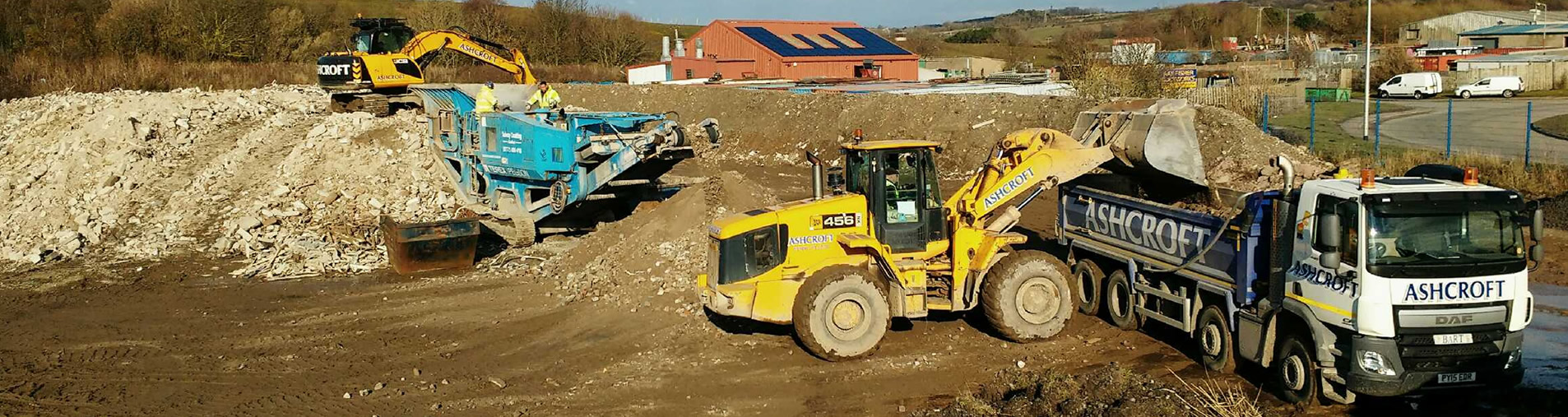
The cheaper route is to sort and recycle. Separated steel goes for scrap and earns some money back. Clean brick, block and concrete can be crushed into aggregate and either reused on the same site as a working platform or hauled to a recycling facility. Timber, plastics and plasterboard go their separate ways. On our own jobs we sort arisings as we go and put masonry and concrete through our crushers; our page on construction waste recycling explains the process. Hazardous waste, such as asbestos and contaminated soil, always costs more and has to be kept separate.
Some buildings pay part of their own way. Lakeland roofing slate, dressed sandstone, old timber beams, cast iron and good bricks all have resale value if they are taken out carefully before the machines go in. Careful salvage takes more labour, so it only makes sense where the material is worth it.
Be clear about the finished state. "Demolish the house" can mean leaving the slab and foundations in, or it can mean grubbing up everything, backfilling and leaving a level, compacted platform ready for the next build. The second option costs more up front, but it is often cheaper than paying a groundworker to do it later. Our demolition process runs from permits right through to grading and dressing the site, so you know what you are getting.
These are broad national ranges drawn from published UK cost guides. They exclude VAT, asbestos removal and anything unusual. They are not our prices, and local quotes can sit either side of them.
Services disconnections, ecology surveys, notices and application fees come on top.
The more a contractor knows, the tighter the price. Send:
When comparing quotes, check they include the same things: asbestos, disconnections, notices, waste and recycling, grubbing up and backfill. The cheapest figure on paper is often the one that leaves something out. If you have a demolition project in Cumbria, get in touch and we will arrange a site visit before we price it.
Our seven-stage demolition process, from securing permits through to grading and dressing the site.
Prior approval, conservation areas, listed buildings and the Section 80 notice explained.